
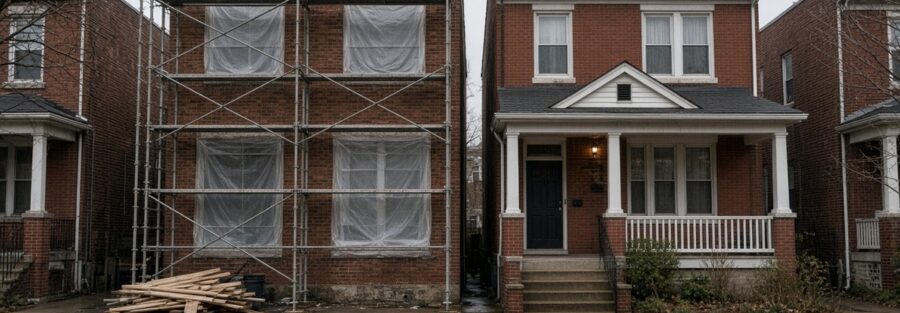
Roxborough work often happens on a shared wall. A typical project here is not a house standing alone in a yard. It is a brick twin or a short row of attached homes, where one side is being gutted while the neighbor still comes and goes through a front door a few feet away. That layout changes the insurance conversation. This article looks at builder’s risk for those tight, attached renovations. It does not promise what a policy will pay, and it does not treat a neighboring house as if it were automatically insured with yours.
Peak Insurance’s office is at 6110 Ridge Avenue in Roxborough. For a citywide overview, see builder’s risk insurance in Pennsylvania and the product page for builder’s risk insurance. The Roxborough page is builder’s risk insurance in Roxborough.
Attached houses and whose policy applies
A builder’s risk policy is generally written for the insured project — the unit, the row house, or the side of the twin that is actually under contract. The house next door is a different property. If work on a party wall, a shared roof, or a common gutter line could affect a neighbor, that is often a liability question as well as a property question. Ask, before demolition starts, who carries general liability, who is named on the builder’s risk form, and how the contract divides responsibility for the shared structure.
If only one side of a twin is being renovated, say that clearly on the application. Describe what is shared and what is independent. Carriers underwrite from the facts they are given.
Occupied remodels on a tight street
Many Roxborough renovations happen while someone still lives in the house, or while the attached neighbor remains in residence even if your unit is vacant. Occupied work and vacant gut jobs are often treated differently on both homeowners forms and builder’s risk forms. Tell the agent whether anyone will sleep in the building, whether heat and water will stay on, and how long the roof or a party wall may be open.
Materials are another tight-street problem. There is often no side yard for a dumpster or a lumber package. Stock may sit in a rear yard, a basement, a storage container, or along the curb. Ask how the form treats materials in those places, and whether overnight storage on the street is treated differently from a locked interior room. Theft and vandalism questions come up on urban sites; the answers belong in the quote, not in a hallway conversation.
What to review before the first wall is opened
- Is this a one-side twin job, a mid-row house, or a detached property?
- What is shared with a neighbor, and who insures that neighbor’s interest?
- Will the building, or the attached unit, be occupied during the work?
- Where will materials and debris sit, including any off-site storage?
- How long will the project last, and what happens if it runs long?
- Does a lender require builder’s risk, and who must be named?
Keep the written answers with the issued policy. If the scope changes — a second floor is opened, a rear addition is added, the neighbor’s roof must be tied in — tell your agent. Changes are subject to the carrier and are not automatic.
What this article does not do
This article does not say that every Roxborough remodel requires builder’s risk, and it does not interpret permit or alley rules. Those, if they apply, should be confirmed with the city office that issues them. Coverage depends on the cause of loss and the policy terms, subject to underwriting and eligibility.
Frequently asked questions
If I renovate only my half of a twin, does the policy cover the neighbor’s side?
Usually it is written for the insured project, not the adjoining property. Shared elements should be described in detail so the carrier and the contractor’s liability coverage can be reviewed together.
We will live in the back rooms while the front is gutted. Is that a homeowners policy or builder’s risk?
It can be either, or a combination that has been reviewed in advance. Partial occupancy is a fact the agent needs in writing. Do not assume the existing homeowners policy has already been expanded to match the open work.
Can Peak Insurance look at a Roxborough project in person?
Our office is on Ridge Avenue in Roxborough. Whether a visit is useful depends on the job and on scheduling. Call 855-449-8552 and describe the work; we can tell you what we need in order to review it.
What if the job is only a kitchen and a bath?
A limited, occupied update is often reviewed first on the homeowners form. A larger or structural job, or a vacant unit, is more often a builder’s risk conversation. Describe the work and let the forms be read against it.
Talk with Peak Insurance
If you are renovating a twin, a rowhome, or another attached house in Roxborough, Peak Insurance can go through these questions with you before the first wall comes down. Call 855-449-8552 or request a quote.
