
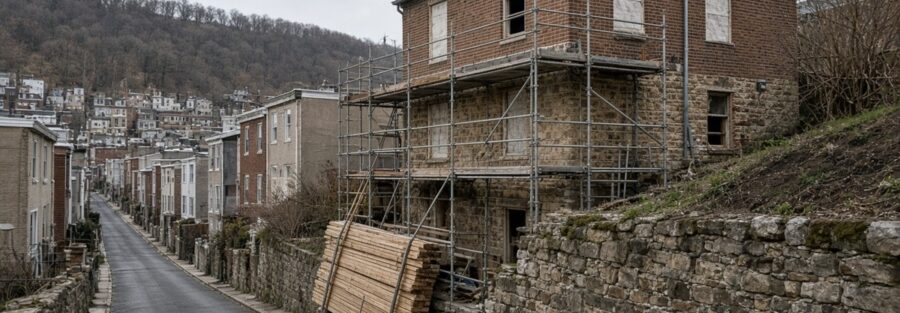
Manayunk projects often start with the slope. An older brick or stone house may sit above a retaining wall, with a narrow street on one side and a drop on the other. Getting a dumpster, a lumber package, or a lift to the right elevation can take as much planning as the interior work. This article looks at builder’s risk for hillside rehabs of older Manayunk homes. It does not set construction methods, and it does not promise that a policy will pay for a given loss.
For the product overview, see builder’s risk insurance. For the state hub and the city page, see builder’s risk insurance in Pennsylvania and builder’s risk insurance in Manayunk.
Older homes on a grade
Many Manayunk houses were built close together on streets that climb away from the river. A rehab can involve opening an old structure, tying into a foundation that was not designed for a modern addition, or working around a retaining wall that holds the lot in place. Those are site conditions to describe on an insurance application. They are not, in this article, a finding about any one address, and they are not a substitute for an engineer’s or contractor’s judgment.
Ask how the builder’s risk form treats the existing structure versus the new work. On an older-home rehab, the value of what is already standing and the value of what will be added are often different numbers. Some forms can include the existing building; others may not, or may do so only if it is scheduled. If the house will be vacant while the interior is taken down to the studs, say so. Vacancy conditions vary.
Access, staging, and materials on a hill
A hillside site can make ordinary storage awkward. Materials may have to sit at the bottom of a flight of steps, on a narrow sidewalk, in a rented space off-site, or on a small rear terrace. Ask whether the form covers those locations, whether there is a sublimit, and whether items in transit between a truck and the house are included. If equipment will be parked on a slope or a lift will be used, mention it. The carrier underwrites the job it is told about.
Weather on a grade is a practical issue. Water runs downhill. Temporary openings, an unfinished roof, or a trench near a retaining wall should be described when you talk about the construction period. Ask what temporary protection the contractor plans to use, and whether the policy has any conditions tied to that.
Questions to bring to the agent
- Is this a rehab of the existing house, an addition, or both?
- Will the building be vacant, or will someone remain in part of it?
- How will crews and materials reach the house, and where will stock be stored overnight?
- Are retaining walls, steps, or a shared wall part of the work, or only next to it?
- How long is the project expected to last, including weather delays?
- Who is named on the policy — the owner, the contractor, a lender, or more than one?
Write the answers down. If the contractor later adds a rear deck, a new foundation, or a second phase, tell your agent before that work starts.
What this article does not do
This article does not interpret hillside, alley, or permit rules, and it does not say that every Manayunk rehab requires builder’s risk. Confirm local requirements with the official office that reviews the property. Coverage depends on the cause of loss and the policy terms, subject to underwriting and eligibility.
Frequently asked questions
The house sits above a stone retaining wall. Does builder’s risk cover that wall?
Only if the wall is part of the insured project and the form actually includes it. A wall that simply borders the lot may be outside the policy. Describe the wall and the work in the application rather than assuming it is included.
We have to store windows at the bottom of the hill for a week. Are they covered?
Storage location matters. Ask whether materials are covered in the open, in a vehicle, in a locker or warehouse, or only after they are carried into the house. Get the answer on the quote.
Can I keep my homeowners policy while a hillside rehab is underway?
Sometimes, with conditions, and sometimes not, especially if the house will be open or vacant. Ask the current carrier and compare that answer with a builder’s risk quote. Do not leave the two policies uncoordinated.
What if the job is delayed because equipment cannot get up the street?
A delay can affect the policy term. Extensions are not automatic. Tell your agent if the schedule slips, and ask what the carrier requires to keep the policy in force.
Talk with Peak Insurance
If you are planning an older-home rehab on a Manayunk hillside, Peak Insurance can review these access, storage, and existing-structure questions with you before the first dumpster arrives. Call 855-449-8552 or request a quote.
