
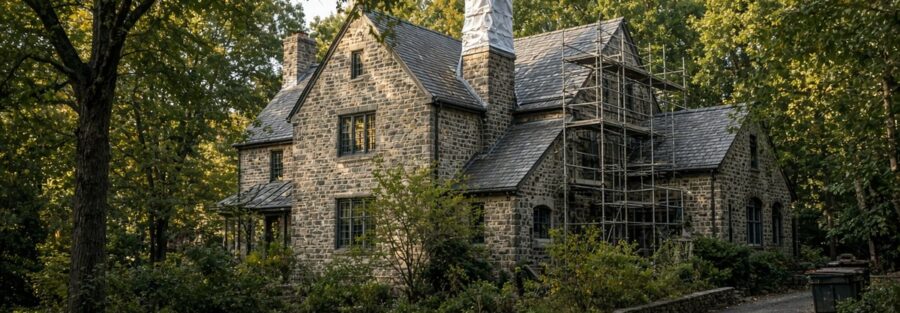
A Chestnut Hill renovation often starts with the masonry. Many houses in the neighborhood are stone, and a project may involve opening a wall, repairing a slate or other specialty roof, or matching materials that are no longer sitting on a lumberyard shelf. Work like that can take longer than a standard frame job, and it can leave a valuable existing structure exposed while the new work is unfinished. This article looks at builder’s risk in that setting. It does not declare any house historic, and it does not promise that a policy will pay for a given loss.
For the product overview, see builder’s risk insurance. For the state hub and the city page, see builder’s risk insurance in Pennsylvania and builder’s risk insurance in Chestnut Hill.
The existing stone house is often the larger value
On many Chestnut Hill jobs, the building already standing is worth more than the increment of new work. That matters on a builder’s risk application. Ask whether the form can include the existing structure, whether it must be scheduled, and how a loss to original masonry or a specialty roof would be valued. A policy written only for the cost of the addition may not be the conversation you think you are having.
If stone, custom millwork, or a particular roof material has a long lead time, say so. A delay waiting for materials can push the job past the original policy term. Extensions are subject to the carrier and should be requested before the expiration date, not after.
Longer work, occupied houses, and temporary openings
Some renovations here happen while the family remains in part of the house. Others empty the building for months. Occupancy, heat, and how long a wall or roof will be open are facts the agent needs in writing. Ask what temporary protection the contractor plans to use when a stone wall is opened or a roof is stripped, and whether the policy has any conditions tied to that protection.
If a property is subject to a historic or design review, confirm that with the official body that would actually review the work. This article does not assign any house to a district and does not interpret those rules. A review, if it applies, can change a schedule, and a changed schedule can affect the insurance term. That is the limited reason to mention it here.
Questions to review before scaffolding goes up
- What is the value of the existing house, and what is the value of the new work?
- Which materials are long-lead or hard to match, and how does that affect the end date?
- Will anyone live in the house during the project?
- How will openings in masonry or the roof be protected in bad weather?
- Where will stone, slate, or millwork be stored if it cannot sit in the driveway?
- Who is named on the policy, including any lender?
Keep the quotes and the issued form with the project file. If the mason’s scope grows, or a second wing is added, tell your agent.
What this article does not do
This article does not say that every Chestnut Hill project requires builder’s risk, and it does not interpret historic, zoning, or permit rules. Confirm those, if they apply, with the official source. Coverage depends on the cause of loss and the policy terms, subject to underwriting and eligibility.
Frequently asked questions
The roof is slate and will be off for several weeks. Does that change the policy?
It can. An open or specialty roof is a fact to put on the application, and it may affect conditions, deductibles, or the term. Ask before the tear-off, not after a storm.
Can the existing stone house be included on a builder’s risk policy?
Sometimes, depending on the form and the carrier. Ask whether it is included, excluded, or available only if it is scheduled, and for what amount. Do not assume an addition policy automatically covers the original walls.
We want to stay in the house while a wing is renovated. Is that allowed under builder’s risk?
It may be, with conditions, or the carrier may want a different arrangement. Partial occupancy should be described in detail. The issued policy, not a general article, controls.
Who decides whether a Chestnut Hill house needs a historic review?
The official body that reviews the property, if any review applies. Peak Insurance can discuss how a delay might affect a policy term. We do not make that historic determination.
Talk with Peak Insurance
If you are renovating a stone home in Chestnut Hill, Peak Insurance can help you review how the existing structure, specialty materials, and the project calendar should appear on a builder’s risk quote. Call 855-449-8552 or request a quote.
