
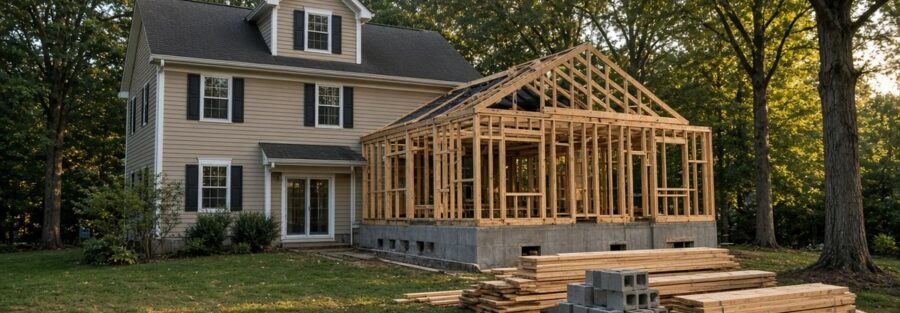
Lafayette Hill work often looks like one of two jobs: a custom house going up on a suburban lot, or a sizable addition tied into a house the family already lives in. Those projects share a ZIP Code and not much else when it comes to insurance. This article separates them and lists what to ask on a builder’s risk quote. It does not interpret township building rules, and it does not promise that a policy will be issued or will pay a particular claim.
For the product overview, see builder’s risk insurance. For the state hub and the city page, see builder’s risk insurance in Pennsylvania and builder’s risk insurance in Lafayette Hill.
A new custom house on the lot
A custom build usually starts as a construction risk, not a homeowners risk. The named insured may be the owner, a builder, or an entity created for the project, and a construction lender often asks to be listed. Ask, in writing, whose name will appear, for what term, and what happens if the finish work runs past the original closing date. A policy written for a nine-month calendar may not match a twelve-month house.
Materials on a suburban lot can sit in a garage pad, a side yard, or a pod. That is simpler than a city curb, but the form may still treat open-yard storage differently from a locked space. Ask about theft, and ask about the unfinished house on evenings and weekends when no crew is present.
An addition on a house you already occupy
Tying a new family room, a second story, or a rear wing into a lived-in house is a different conversation. The existing dwelling may stay on a homeowners policy. The new work may belong on builder’s risk, on the homeowners form with renovation conditions, or on a combination that has been reviewed in advance. The useful step is to put both policies on the table and describe the opening that will be cut: how wide, how long it will stay open, and whether anyone will remain in the house.
Ask who is responsible if weather enters at the tie-in, and whether that is meant to be a homeowners question, a builder’s risk question, or a matter of the construction contract. Then confirm that the insurance actually in force matches that understanding. Do not leave it as a handshake between owner and contractor.
If a teardown-and-rebuild is closer to what you are doing than an addition, say that clearly. Those two jobs are not the same on an application.
Questions that belong on the quote
- Is this a new custom house, an addition, a teardown, or a mix?
- Who will live on the property during the work, if anyone?
- What is the expected start and end date, including interior finish?
- Who must be named — owner, builder, lender?
- How are the existing house and the new work valued if both are involved?
- Where will materials be stored, and is the site unattended at night?
If the addition later becomes a second phase, or a custom house adds a detached garage mid-job, tell your agent before that work starts. Changes are subject to the carrier.
What this article does not do
This article does not say that every Lafayette Hill project requires builder’s risk, and it does not interpret township, zoning, or permit rules. Confirm those with the official office that reviews the property. Coverage depends on the cause of loss and the policy terms, subject to underwriting and eligibility.
Frequently asked questions
We are adding a large rear room and will keep living in the front of the house. Which policy applies?
Both may need to be read together. Ask the homeowners carrier and compare that answer with a builder’s risk quote for the new work. Describe the opening between the two parts of the house.
Our builder is putting up a custom home and already has a policy. Do we still need to be named?
If you have a financial interest in the project, ask whether that interest is actually listed. Do not assume the builder’s policy automatically protects the owner, or the other way around. Confirm it on the issued form.
What if we decide mid-job to finish a bonus room that was not in the first quote?
Tell your agent before the extra work begins. A change in scope or value can matter to the term and the limit. It is easier to ask in advance than after a loss in a space the carrier was not told about.
Does a small, occupied kitchen update need builder’s risk?
A limited update may be reviewed entirely on the homeowners policy. A structural addition or a new custom house is worth a dedicated builder’s risk review. When in doubt, describe the work and ask.
Talk with Peak Insurance
If you are planning a custom home or an addition in Lafayette Hill, Peak Insurance can help you sort which structure belongs on which policy before the first inspection. Call 855-449-8552 or request a quote.
