
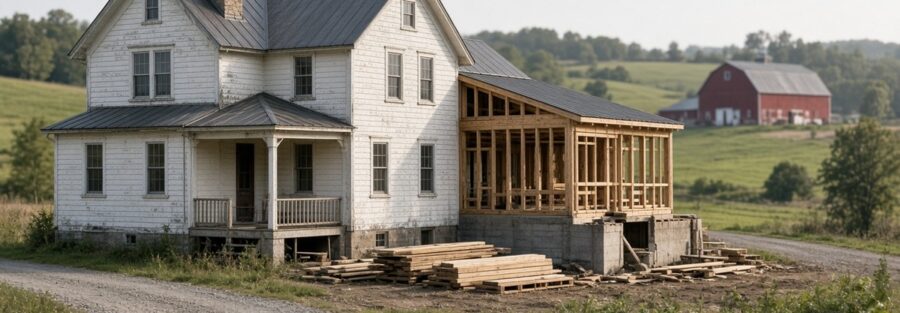
Chester County work often comes in two very different shapes. One is a new house in a subdivision or on a recently divided lot. The other is an older farmhouse, barn, or outbuilding being converted or expanded on land that still feels rural. Both can be builder’s risk conversations, but they should not be described as if they were the same job. This article separates the two and lists what to ask. It does not interpret township or agricultural zoning rules, and it does not promise that a policy will pay for a given loss.
For the product overview, see builder’s risk insurance. For the state hub and the county page, see builder’s risk insurance in Pennsylvania and builder’s risk insurance in Chester County.
A new house in a subdivision or on a new lot
A new dwelling is typically a construction risk until it is finished and occupied. The named insured may be a production builder, a custom builder, or an owner, and a lender often asks to be listed. Ask for the term that matches the real calendar, including the time after the shell is up and the interior is still open. If several houses in the same development are underway, confirm whether your policy is specific to your lot or is part of a broader program the builder already has, and whether your interest is actually named.
Materials in a new community can sit on a muddy lot with little secure storage. Ask how open-yard lumber, windows, and appliances are treated, and what happens on a site that is quiet at night and on weekends. If the house is one of many going up at once, theft and mixing of materials between lots are practical questions, not accusations.
A farmhouse conversion or a rural addition
An older farmhouse, a barn conversion, or an addition that ties into a standing rural building brings the existing structure into the conversation. Ask whether the form includes that building, excludes it, or requires it to be scheduled, and for what amount. A policy written only for new framing may not address a fire or a collapse involving the original house or an attached outbuilding.
If more than one building is on the property — a house, a barn, a workshop — say which structures are part of the work and which are not. A project that “includes the barn later” should be described now or added later in writing, not left as a verbal plan. Access can also be different from a subdivision street. If crews or deliveries travel a long lane, mention how materials will be stored and how a fire department or a contractor would reach the site. That is a site fact for the application, not a local-rule claim.
Questions to review before the first pour or the first tear-out
- Is this a new house, a conversion, an addition, or a mix?
- Which buildings on the property are part of the insured work?
- Who is named — owner, builder, lender?
- How long will the project last, including finish work?
- Where will materials sit, and is the site unattended for long stretches?
- If the existing farmhouse or barn is involved, how is it valued on the form?
If a phase is added — a garage, a second dwelling, a barn delayed until spring — tell your agent before that work starts.
What this article does not do
This article does not say that every Chester County project requires builder’s risk, and it does not interpret land-use, farm, or permit rules. Confirm those with the official office that applies to the property. Coverage depends on the cause of loss and the policy terms, subject to underwriting and eligibility.
Frequently asked questions
We are converting a barn and also building a new garage. Is that one policy?
It can be, if both structures are described and valued on the same form, or it may be quoted in parts. The important step is that no building in the work is left off the application by accident.
The new house is in a development, and the builder says they already have coverage. Should we still be listed?
If you have a financial interest, ask whether that interest is named on the issued policy. A builder’s program policy may or may not include you. Confirm it in writing.
Our farmhouse will stay occupied while a rear wing is added. Which form applies?
The existing house and the new work may need to be reviewed together, on a homeowners policy, a builder’s risk policy, or both. Describe the opening and the occupancy in detail.
The lot is a long way from a main road. Does that matter?
It can matter to how the site is described, how materials are stored, and how a loss would be reached. Put the access facts on the application rather than assuming they are irrelevant.
Talk with Peak Insurance
If you are building a new house or converting an older farm property in Chester County, Peak Insurance can help you describe the right structures and the right term on a builder’s risk quote. Call 855-449-8552 or request a quote.
