
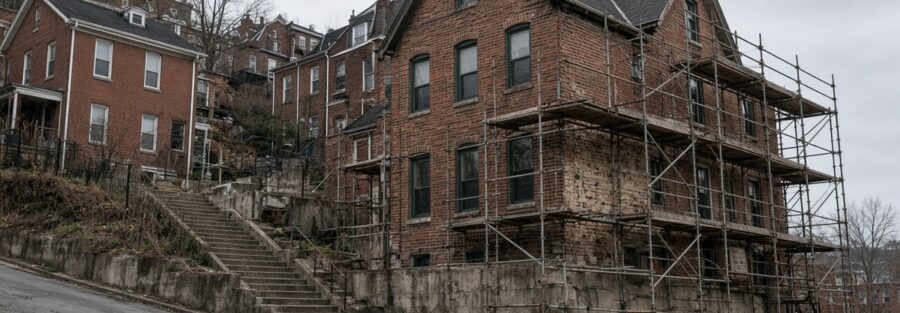
A Pittsburgh project often has to deal with the hill before it deals with the kitchen. An older brick house may sit on a steep lot, above a retaining wall, with a long stair from the street and little room to stage materials. That combination — older housing stock plus a grade — is the focus of this article. It is about what to ask on a builder’s risk quote. It does not grade your slope, and it does not promise that a policy will pay for a given loss.
For the product overview, see builder’s risk insurance. For the state hub and the city page, see builder’s risk insurance in Pennsylvania and builder’s risk insurance in Pittsburgh.
Older houses and what is already standing
Much of the work in the city is a rehab or an addition to a house that has been there for decades. The existing structure and the new work may be valued differently. Ask whether the builder’s risk form includes the standing house, excludes it, or includes it only if it is scheduled. If the interior will be taken back to the studs, or if a wall will be opened on the downhill side, say so. Vacancy, heat, and how long the building will be open are facts the carrier needs in writing.
Winter is a practical part of a Pittsburgh calendar, not a slogan. An open roof or an unheated shell in January is a different condition than the same opening in June. Ask how the form treats the building during a pause in the work, and whether the term can be extended if weather or access pushes the end date.
Steep lots, retaining walls, and staging
A steep lot can turn ordinary deliveries into a project of their own. Materials may sit at street level while the house sits a flight of stairs above, or they may have to be carried across a narrow side yard. Ask where the form covers those materials — on the street, on a landing, in a truck, or only after they are inside. If a lift, a crane, or a temporary chute will be used, mention it.
If a retaining wall, a stair, or a hillside foundation is part of the work, describe it as part of the project. If it is only next to the work, say that too. A wall that holds the lot and a wall that is being rebuilt are not the same item on an application. This article does not interpret hillside or grading rules. Confirm those, if they apply, with the official office that reviews the property.
Questions to bring before scaffolding goes up
- Is this a rehab, an addition, a new house on a steep lot, or a mix?
- Will the building be vacant, and for how long?
- How will crews and materials reach the house from the street?
- Are retaining walls, stairs, or foundation work part of the insured project?
- How long is the expected term, including a possible winter pause?
- Who is named — owner, contractor, lender?
If the contractor later adds foundation work or a rear deck on the downhill side, tell your agent before that work starts.
What this article does not do
This article does not say that every Pittsburgh project requires builder’s risk, and it does not interpret grading, landslide, or permit rules. Confirm those with the official source that applies. Coverage depends on the cause of loss and the policy terms, subject to underwriting and eligibility.
Frequently asked questions
The house is on a steep lot. Does that automatically change the premium or the form?
This article does not quote premiums. A steep site is a fact to describe — access, staging, foundation work, retaining walls — so the carrier can underwrite the actual job. Put those facts on the application.
We need to leave the house unheated for two winter months. Does that matter?
It can. An unoccupied or unheated period should be described, and it may affect conditions on the form. Ask before the heat is turned off.
Our older brick house will stay partly occupied during a rehab. Is that still builder’s risk?
It might be reviewed on builder’s risk, on a homeowners policy, or on both. Partial occupancy and an open structure should both be disclosed. The issued forms control.
Materials will sit at the bottom of a long stair for days at a time. Are they covered?
Ask where the form covers storage and transit, and whether there is a sublimit. A landing at the street is not always treated the same as a locked room in the house.
Talk with Peak Insurance
If you are rehabbing an older house or building on a steep Pittsburgh lot, Peak Insurance can go through these access, winter, and existing-structure questions with you before the scaffolding goes up. Call 855-449-8552 or request a quote.
