
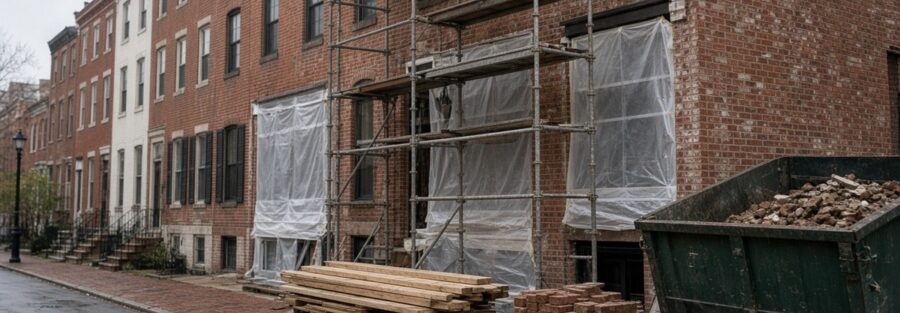
If you are opening up a Philadelphia rowhome or starting a new house in Pennsylvania, it is easy to assume the policy already on the property will see the project through. People type questions such as “builders insurance for homeowners” for that reason. A homeowners policy and a builder’s risk policy — sometimes called course of construction insurance — are written for different stages of a property. This article explains the difference in plain terms. It does not promise what any one policy will pay.
What a homeowners policy is set up to do
A homeowners policy is usually written for a finished dwelling that is being lived in. It may cover the house and personal property against certain perils, subject to the deductibles, exclusions, and conditions in the issued policy. During a light update — paint, a kitchen refresh, or other work that leaves the house occupied and weathertight — many people start by reviewing that policy with their agent. Occupancy, vacancy, and renovation conditions vary by form and by carrier. The issued policy, not a blog post, controls.
Peak Insurance has a separate article, Philadelphia Rowhouse Renovation Insurance Review, that walks through homeowners questions during a city renovation, including dwelling limits and a short paper trail. That piece stays useful for the homeowners side of the conversation. This post is about a different product: builder’s risk.
What builder’s risk, or course of construction, is set up to do
Builder’s risk is temporary property coverage for a structure while it is being built or substantially renovated. It is often written for the value of the work and the materials, and, depending on the form, all or part of the existing structure. The policy term is usually tied to the expected construction period. An owner, a contractor, or both may be named as insureds, and a construction lender often asks to be listed. None of that is automatic. Eligibility, limits, and who can be named are decided by the carrier when the policy is issued.
For a general overview, see builder’s risk insurance from Peak Insurance. The notes below compare that product with a homeowners policy during a Pennsylvania remodel or a new build.
When a Philadelphia or Pennsylvania project may need both conversations
A gut renovation, a new rear addition, a teardown, or a house that will sit open to the weather can fall outside what a standard homeowners form was designed to do. Some carriers restrict or exclude coverage when a home is vacant, when walls or the roof are open, or when the work is structural. Other carriers may be willing to keep a homeowners policy in force during a limited renovation, with conditions. The only reliable way to know is to describe the job in detail and review the actual forms.
On a Philadelphia block, the site is often tight. Lumber and fixtures may sit in a rear yard, a basement, or along the curb. Many houses share walls with a neighbor. Those facts raise questions for both property coverage and liability coverage. A builder’s risk policy is generally written for the insured project, not the house next door. Damage that involves a neighboring property is often a liability question, which is a separate discussion. For city-specific project questions, see builder’s risk insurance in Philadelphia. For the rest of the state, see builder’s risk insurance in Pennsylvania.
Questions to review before demolition or a new foundation
Bring these points to your agent or to the contractor before work starts:
- Will anyone live in the building during the work, or will it be vacant?
- What remains of the existing structure, and what is new work?
- How long is the project expected to last, and what happens if the schedule runs long?
- Where will materials be stored, including any off-site storage or items in transit?
- Does a lender require a builder’s risk policy, and who must be named on it?
- Who is responsible for arranging the policy — the owner, the general contractor, or both?
Keep the quotes, the applications, and the issued policy with the project file. If the scope or the timeline changes, tell your agent. Extensions are subject to the carrier’s rules and are not automatic.
What this article does not do
This article does not say that a homeowners policy will or will not pay for a given loss, and it does not say that builder’s risk is required for every Pennsylvania remodel. Coverage depends on the cause of loss and the policy terms, subject to underwriting and eligibility. Permit or historic-review steps, if they apply, should be confirmed with the city or township that issues them.
Frequently asked questions
Does my homeowners policy cover a remodel in Philadelphia?
It depends on the work, on whether the house stays occupied, and on the wording of your policy. A light, occupied update is often reviewed first on the homeowners form. A larger or open project may need a separate builder’s risk conversation. Ask your agent to read the actual conditions before demolition starts.
What is course of construction insurance?
It is another name for builder’s risk: temporary property coverage for a building while it is being built or substantially renovated. The form, the term, and who is named vary by carrier. See our builder’s risk insurance page for the general overview.
If I live in the house during the work, do I still need builder’s risk?
Not automatically, and not in every case. Occupied remodels and vacant gut jobs are often treated differently. Some projects use a homeowners policy, a builder’s risk policy, or a combination that has been reviewed in advance. The right structure depends on the job and on what a carrier will actually issue.
Who should be listed on a builder’s risk policy?
Owners, general contractors, and lenders are commonly discussed as named insureds or interest holders. Who must appear, and in what role, depends on the contract, the loan, and the carrier. Confirm it in writing on the issued policy.
Talk with Peak Insurance
If you are planning a remodel or a new build in Philadelphia or elsewhere in Pennsylvania, Peak Insurance can go through these questions with you. Call 855-449-8552 or request a quote.
