
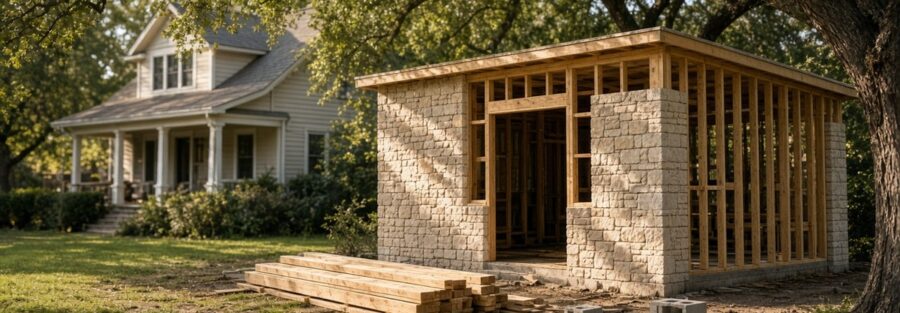
A lot of Austin work is not a vacant tract with one house in the middle. It may be a backyard accessory dwelling going up while the main house stays occupied, a spec home a builder plans to sell, or an addition tied into a house that already has a homeowners policy. Those three jobs raise different insurance questions. This article separates them and lists what to review on a builder’s risk quote. It does not interpret city ordinances, and it does not promise that a policy will be issued or will pay a particular claim.
For the product overview, see builder’s risk insurance. For statewide context and the city page, see builder’s risk insurance in Texas and builder’s risk insurance in Austin.
A backyard ADU while the main house is lived in
An accessory dwelling — a casita, a garage apartment, a small cottage at the rear of the lot — is a second structure. The house in front may already be insured as a homeowners risk. The new unit, while it is framed and open, is often a construction risk. Do not assume that the homeowners policy on the main house covers the ADU during construction, or that a builder’s risk policy on the backyard unit changes coverage on the occupied house.
Ask, in writing:
- Which structure is being insured under the builder’s risk quote, and for what value?
- Does the main house stay on its current homeowners policy, and has that carrier been told about the work taking place on the same lot?
- How are shared items treated — a trench for utilities, a new driveway apron, a fence that has to come down and go back up?
- Who is the named insured on each policy, especially if a family member, a contractor, or a future tenant will be involved?
- When the ADU is finished, what policy is meant to pick it up, and when does the builder’s risk end?
If the yard is tight and materials sit between the two buildings, say so. Site access and storage are ordinary construction details that belong on the application.
Use, size, parking, and permit questions should be confirmed with the city or other jurisdiction that reviews the project. This article does not interpret those rules.
A spec home built to sell
A spec house is started without a particular buyer living in it, and the builder’s timeline runs to a sale date that can move. The named insured is often the builder or the entity that owns the lot. A construction lender, if there is one, typically asks to be listed. Questions that come up on this kind of Austin project include:
- Who owns the dwelling during construction, and is that the same name on the policy?
- What happens if the house sits finished, or nearly finished, longer than planned before a buyer closes?
- How is theft or vandalism treated on a site that may have periods with no crew present?
- When a buyer is under contract, does their insurance need to be coordinated at closing, and who is responsible for the gap?
A policy written for a shorter build may not match a longer calendar. Extensions are subject to the carrier. If the form has vacancy or unoccupied conditions, read them before the house sits empty on evenings and weekends.
An addition on a house you already live in
Tying a new wing, a second story, or a large rear addition into an occupied house sits between the two cases above. The existing structure and the new work may be treated differently. Some homeowners policies have renovation conditions. Some builder’s risk forms can include, or can exclude, the existing dwelling. The useful step is to put both policies on the table and describe the opening that will be cut, how long the house will be open to the weather, and whether anyone will remain in residence.
Ask who is responsible if water enters at the tie-in, and whether that is a homeowners question, a builder’s risk question, or a matter of the construction contract. Then confirm that the insurance actually in force matches that understanding. Do not leave it as an assumption between owner and contractor.
What this article does not do
This article does not say that every Austin ADU, spec home, or addition requires builder’s risk, and it does not interpret land-use or building rules. Those rules should be confirmed with the official source that applies to the property. Coverage depends on the cause of loss and the policy terms, subject to underwriting and eligibility.
Frequently asked questions
Can I add the ADU to my existing homeowners policy while it is being built?
Sometimes a carrier will consider that, and sometimes it will not, or it will do so only after the unit is finished. Ask the current homeowners carrier first, and compare that answer with a builder’s risk quote for the construction period. Do not assume the existing policy has already picked up a new structure in the yard.
If I am building a spec home in Austin, should the future buyer be named now?
Usually the buyer is not an owner yet. Naming should follow the actual interest in the property and the loan. When a sale is under contract, ask your agent and the title or closing team how the insurance should be handled through the closing date so there is no silent gap.
My addition will open the back wall of a house we live in. Is that still a homeowners claim if rain gets in?
It might be reviewed on the homeowners policy, on a builder’s risk policy, or not covered, depending on the forms and the facts. The time to sort that out is before the wall is opened, not after a forecast turns into a wet interior.
Does a short, weekend project need this review?
A small cosmetic project may be handled entirely on the homeowners policy. A new dwelling, a new ADU, or a structural addition is worth a dedicated review. When in doubt, describe the work and let the agent tell you which forms they want to see.
Talk with Peak Insurance
If you are planning an ADU, a spec home, or an addition in Austin, Peak Insurance can help you sort which structure belongs on which policy, and who should be named. Call 855-449-8552 or request a quote.
