
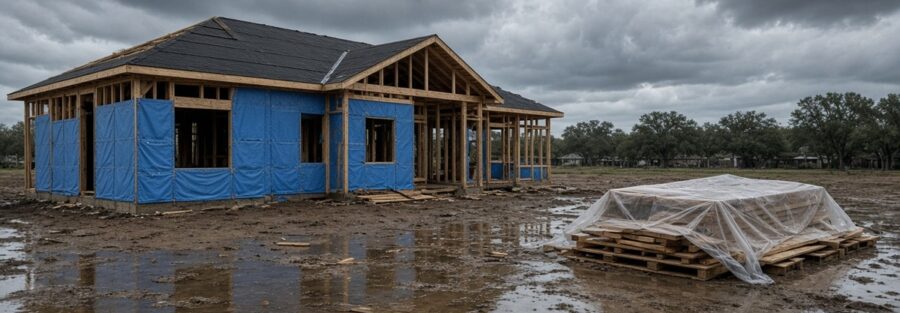
A Houston project can be standing as an open wood frame, with house wrap and an unfinished roof, when a line of storms moves across the Gulf Coast plain. That is the moment to have already asked how the builder’s risk quote treats wind, a named storm, and flood. This article is a list of questions to take to your agent, your contractor, and, where it applies, your lender. It is not a prediction of what any policy will pay, and it is not a substitute for official flood-map information on the specific lot.
For a general overview of the product, see builder’s risk insurance. For Texas terms and the Houston city page, see builder’s risk insurance in Texas and builder’s risk insurance in Houston.
Start with the weather the site can actually see
Southeast Texas gets heavy rain, tropical systems, and strong wind. A lot that sits on a prairie drainage path can hold water after a storm even when the finished neighborhood looks ordinary on a dry day. Those are reasons to read a quote slowly. They are not a finding about your parcel. Flood-zone determinations and map revisions come from official sources, including the flood maps published for the community. Pull the information for the legal description or address, and bring it to the insurance conversation. Do not rely on a memory of a nearby street.
Wind and flood are often treated as different problems on insurance forms. A builder’s risk quote may include certain wind coverage, exclude flood, or offer flood only on a separate form or endorsement. None of those outcomes should be assumed. Ask for the exclusions and the deductibles in writing.
Questions to ask before the foundation is poured
- Is flood included on the builder’s risk form being quoted, excluded, or available only on a different policy?
- How does the quote treat wind, and is there a separate deductible for a named storm or a hurricane?
- If the frame is up and the windows or roof are not finished when a storm arrives, what conditions apply?
- Are materials covered while they sit in the open, under a temporary tarp, in a storage container, or only after they are installed?
- How are a job trailer, temporary power, or a portable toilet treated, if they are on the site at all?
- Who is responsible for securing an open structure when a storm is in the forecast — the owner, the general contractor, or both?
- If the project is delayed by weather, can the policy term be extended, and what does the carrier require?
Write the answers next to the quote. If two carriers answer them differently, that difference matters more than a short summary on a website.
Materials, mud, and an unfinished roof
Houston job sites often have a long stretch when lumber, windows, and HVAC equipment sit on pallets in the yard. After a heavy rain, that yard can be standing water. Ask whether the form distinguishes between materials in the open and materials in a locked container or a warehouse, and whether there is a sublimit. If the roof deck is on but the finished roofing is not, ask how wind-driven rain is treated during that window. The answers vary. Temporary protection — tarps, house wrap, braced openings — may be a condition of coverage, a practical job-site step, or both. Confirm what the carrier expects, and keep a short record of what was in place after a storm warning.
Flood is a separate conversation
People sometimes use “storm damage” to mean both wind and water from the ground or from a rising bayou. Insurance forms often split those causes. If flood is excluded from the builder’s risk policy, ask what, if anything, can be written for the construction period, and how a finished-home flood policy would later replace it. Waiting periods and eligibility rules, when they apply, belong in that review. Peak Insurance can help you compare the questions. We cannot change a flood map or bind a coverage that a carrier will not offer.
What this article does not do
This article does not assign a flood zone to any Houston lot, does not quote a deductible, and does not say that builder’s risk will pay for a particular storm. Coverage depends on the cause of loss and the policy terms, subject to underwriting and eligibility. Building, drainage, and elevation requirements, if they apply, should be confirmed with the local government that issues the permit. They are not decided in this post.
Frequently asked questions
Does builder’s risk automatically include flood in Houston?
No. Flood may be included, excluded, or offered only on another form. The quote and the issued policy are the place to look, not a general article.
What should I do if a storm is forecast and the house is still open?
Ask the contractor and your agent, before that day arrives, who is responsible for temporary protection and what the policy requires. After the weather passes, photograph the site and note the time, and call your agent if there is a loss to report. Follow the notice terms in the policy.
Can I use a homeowners policy on a new Houston house that is not finished?
A homeowners policy is usually written for a completed, occupied dwelling. A house under construction is more often a builder’s risk discussion. If someone will live on the site, or if an existing house is being expanded, describe that arrangement in detail so the forms can be reviewed together.
Where do I check whether a lot has a flood-map designation?
Use the official flood-map information for the community and the specific property. Your surveyor, lender, or local floodplain administrator may also point you to the current panel. Bring that document to the insurance review rather than relying on a nearby address.
Talk with Peak Insurance
If you are planning a new home or a major addition in Houston, Peak Insurance can go through these wind, storm, and flood questions with you before the first pour. Call 855-449-8552 or request a quote.
