
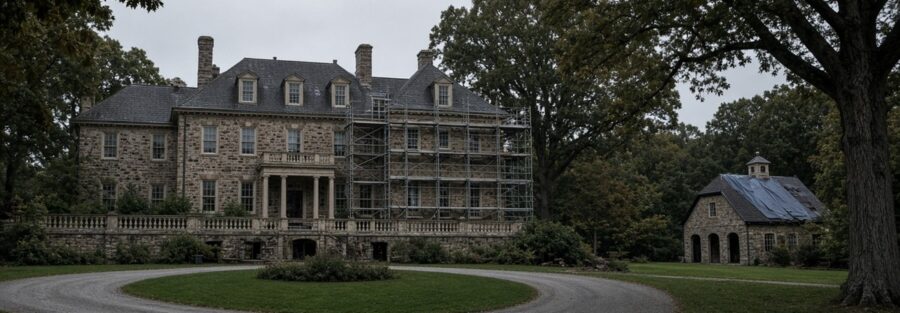
A Sewickley Heights project is often not a single box of a house. It may be a main dwelling under renovation, a carriage house or other outbuilding in the same campaign, and a calendar that runs in phases rather than in one straight line. That is the focus of this article: how to talk about builder’s risk when more than one structure, and more than one phase, may be on the same grounds. It does not assign a value to any estate, and it does not promise that a policy will pay for a given loss.
For the product overview, see builder’s risk insurance. For the state hub and the city page, see builder’s risk insurance in Pennsylvania and builder’s risk insurance in Sewickley Heights.
More than one building on the same grounds
If the work includes the main house and a secondary building, say so on the application and give each structure a description and a value. A policy written only for the main renovation may not automatically pick up a carriage house, a garage apartment, or a later outbuilding even when they share a drive. Ask whether one form can schedule several buildings, or whether a later phase needs a separate review when that work actually starts.
If one building will be occupied while another is open — a family living in the main house while a guest house is gutted, or the reverse — that split should be written down. Occupancy on one structure and vacancy on another can point to different forms, or to conditions on the same form. Do not assume a single homeowners policy on the estate has already absorbed every building under construction.
Phased work and a long calendar
Estate renovations often proceed in phases: the roof and exterior first, interiors later, an outbuilding in a second year. A builder’s risk term that matches only the first phase can expire while crews are still on site. Ask how a phase will be added, and whether an extension or a new policy is the carrier’s usual path. Extensions are not automatic.
If an owner’s representative, a general contractor, and several specialty trades will share the site, naming and liability remain separate conversations from the property form. Builder’s risk, depending on the policy, is about the structures and certain materials during the work. Who is responsible if two trades overlap on a loss is a contract and liability question as well.
Questions to settle before the first phase begins
- Which buildings are part of the work now, and which are only possible later?
- What is the value of each structure being insured?
- Who will occupy which building during each phase?
- What is the expected end date of the current phase, and of the whole campaign if it is known?
- Who is named — owner, entity, contractor, lender, or a combination?
- Where will materials and fixtures be stored on a large, quiet site?
If a later phase is approved mid-project, tell your agent before that work starts so the insurance file can be updated.
What this article does not do
This article does not say that every Sewickley Heights project requires builder’s risk, and it does not interpret municipal or permit rules. Confirm those with the official office that reviews the property. Coverage depends on the cause of loss and the policy terms, subject to underwriting and eligibility. No property value or premium is stated here.
Frequently asked questions
We are renovating the main house this year and the carriage house next year. Can one policy cover both?
It may be possible to schedule both if the later work is known and valued now, or it may be cleaner to review the second building when that phase starts. Ask the carrier which path they will actually offer, and do not leave the second building unspoken.
We will live in the main house while an outbuilding is open. Does our homeowners policy handle that?
The occupied house and the building under construction may need two different reviews. Ask the homeowners carrier about the work on the grounds, and compare that with a builder’s risk quote for the open structure.
Several firms will be on site at once. Whose policy pays if materials are damaged?
That depends on the property form, the contracts, and any liability coverage. Naming, the construction agreement, and the builder’s risk form should be read together. This article cannot assign fault.
The project may last two years. Should we buy a two-year term now?
Ask for a term that matches the known work, and ask how an extension or a renewal would be handled if the campaign runs longer. A longer term may or may not be available up front. The carrier’s answer belongs in writing.
Talk with Peak Insurance
If you are planning an estate renovation in Sewickley Heights, including work on more than one building, Peak Insurance can help you map the structures and the phases onto a builder’s risk review before the first phase starts. Call 855-449-8552 or request a quote.
